The 72-Hour Blackout Defense: Battery Sizing, Off-Grid Inverters, and Essential Circuit Isolation
When regional transmission substations fail or rolling blackouts strike, surviving the first 72 hours requires systematic energy triage. Here is your cold calculation blueprint for essential load auditing, surge wattage, and circuit isolation.
When regional transmission substations fail or rolling blackouts strike, surviving the first 72 hours requires systematic energy triage. Here is your cold calculation blueprint for essential load auditing, surge wattage, and circuit isolation.
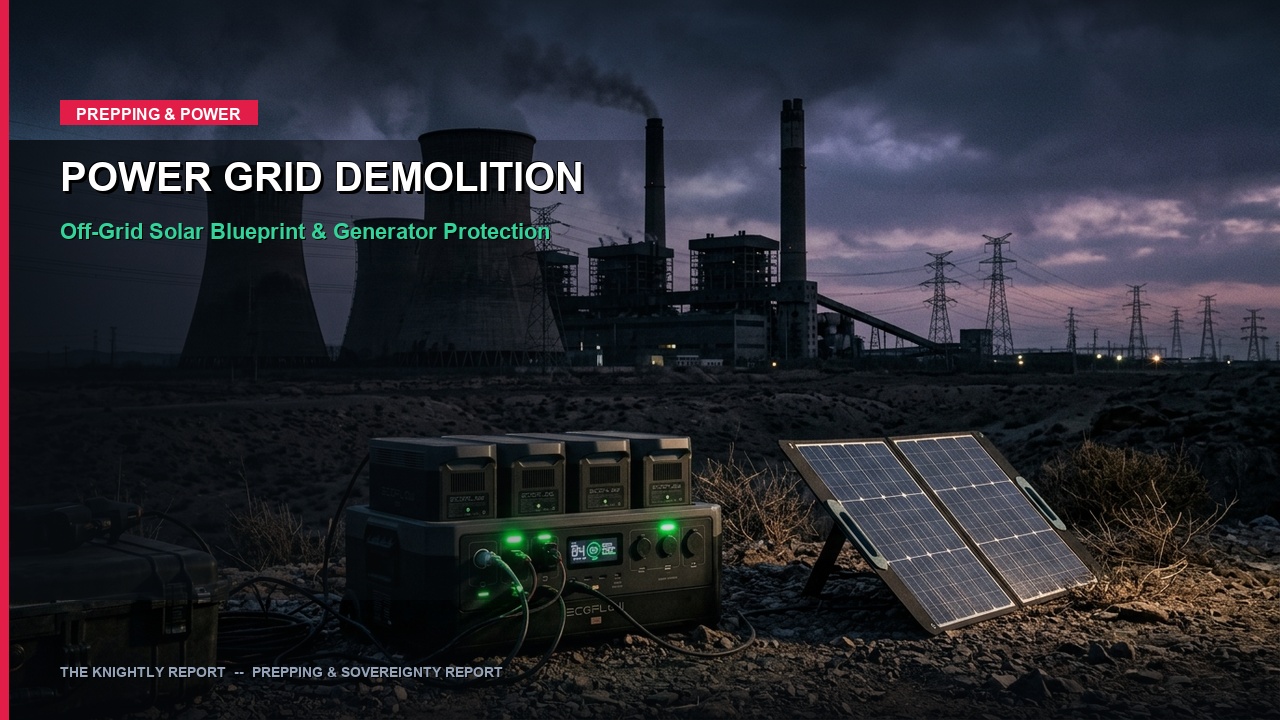
When an unexpected grid failure strikes—whether triggered by severe weather, physical substation sabotage, cyber infiltration, or forced rolling utility brownouts—the first 72 hours determine whether your home remains a secure fortress or descends into a cold, dark liability. Most homeowners make the fatal mistake of attempting to power their entire house as if life were normal. In an emergency, this rapidly exhausts battery reserves and leaves essential medical and food-preservation systems dead within twelve hours.
True energy resilience requires ruthless electrical triage. Surviving an extended outage is not about comfort; it is about keeping perishable rations preserved, maintaining vital communications, powering emergency water pumps, and operating life-critical medical equipment without drawing external attention.
1. The First 72 Hours: Why the Opening Window Is Critical
Municipal water towers generally maintain pressure for 12 to 24 hours post-blackout before auxiliary generators exhaust fuel or booster pumps stall. Cellular towers, engineered with lead-acid battery backup banks, typically lose voice and data throughput between 2 and 6 hours. Emergency response services quickly become inundated with priority dispatch calls.
During this critical 72-hour window, personal energy independence is the dividing line between calm operational security and panicked scrambles for supplies. Having pre-calculated, dedicated off-grid power prevents frantic troubleshooting in the dark.
2. Cold Calculations: Running Watts vs. Surge Watts (LRA vs. FLA)
The most dangerous trap in off-grid power planning is sizing a battery system solely on running watts (Full Load Amps or FLA) while ignoring starting surge watts (Locked Rotor Amps or LRA). Inductive loads—appliances with electric motors or compressors—require between 3x to 6x their continuous power rating for several seconds upon compressor startup.
• Full-Size Refrigerator: 150W running / 1,200W–1,800W initial inductive surge (1–3 seconds)
• Deep Chest Freezer: 100W running / 900W–1,400W initial compressor surge
• 1/2 HP Sump Pump: 800W running / 2,100W–2,800W starting surge
• Well Pump (240V, 3/4 HP): 1,500W running / 3,500W–4,500W starting surge
• Medical CPAP (heated humidifier disabled): 35W–55W continuous (Zero surge)
• Starlink Satellite Dish: 50W–75W continuous (Zero surge)
If your off-grid inverter cannot sustain that instantaneous inductive spike, its internal breaker will trip into overload protection, cutting power to your entire emergency bus.
3. Calculating Daily Watt-Hour (Wh) Consumption
To accurately calculate battery capacity, multiply each appliance's running wattage by the exact operational hours per 24-hour cycle. A refrigerator does not run 24 hours continuously; its compressor cycles approximately 20 to 25 minutes per hour (roughly 8 to 10 run-hours per day).
| Essential Appliance | Watts (Avg) | Daily Run Time | Daily Energy (Wh) |
|---|---|---|---|
| Energy Star Refrigerator | 150W | 9 hours | 1,350 Wh |
| Chest Freezer (5 cu. ft.) | 80W | 8 hours | 640 Wh |
| Medical CPAP Machine | 45W | 8 hours | 360 Wh |
| Starlink / Off-Grid Comms | 60W | 6 hours (rationed) | 360 Wh |
| LED Tactical Lighting & Phones | 25W | 6 hours | 150 Wh |
| Baseline Daily Total | - | - | 2,860 Wh / Day |
Factoring in inverter DC-to-AC conversion losses (typically 12% to 15% efficiency loss), a household targeting 72 hours of uninterrupted off-grid capability without immediate solar replenishment requires a minimum of 3,300Wh to 4,000Wh of stored capacity, supplemented by continuous solar replenishment.
4. Battery Chemistry: Why LiFePO4 Outlasts Legacy Lead-Acid and NMC
Never rely on sealed lead-acid (SLA) AGM batteries or standard Lithium-Cobalt/NMC cells for serious emergency defense. The differences in depth-of-discharge (DoD) and safety are stark:
- Lead-Acid (AGM/Gel): Usable capacity is capped at 50% DoD. Discharging beyond 50% irreversibly damages the lead plates and collapses battery voltage under high inductive loads. A 200Ah 12V AGM battery rated at 2,400Wh only provides 1,200Wh of usable power.
- Lithium NMC (Nickel Manganese Cobalt): High energy density, but cycle life degrades after 500 to 800 cycles. Susceptible to thermal runaway if punctured or subjected to internal short-circuits.
- Lithium Iron Phosphate (LiFePO4): The gold standard for off-grid survival. Allows 90% to 100% Depth of Discharge with zero fire hazard, high chemical thermal stability, and 3,500+ full charge cycles to 80% remaining capacity. A LiFePO4 battery bank cycled daily will provide reliable service for over a decade.
5. Critical Circuit Isolation: Transfer Switches vs. Dangerous Backfeeding
Never plug a male-to-male "suicide cord" from a generator or portable power station into a wall outlet without disconnecting the main grid breaker. Not only is this illegal under the National Electrical Code (NEC Article 702), but backfeeding the grid can electrocute linemen working down the road to restore high-voltage lines.
To safely power hardwired circuits (furnace blowers, well pumps, or kitchen outlets), install one of two approved mechanical transfer solutions:
- Mechanical Interlock Kit: A steel plate installed on your main panel that physically prevents the generator breaker from engaging unless the utility main breaker is switched OFF.
- Dedicated Critical Loads Transfer Switch: A subpanel wired to 6 to 10 designated breaker circuits (refrigerator, well pump, comms, medical bedroom). The subpanel allows toggle selection between UTILITY and GENERATOR for each individual breaker.
6. The Solar Replenishment Ratio: The 2:1 Field Rule
A battery bank without solar replenishment is merely an oversized countdown timer. However, expecting 400W of rated solar panels to produce 400W in an emergency is a recipe for battery depletion. Solar panels rarely operate at 100% laboratory Standard Test Conditions (STC) due to atmospheric haze, winter azimuth angles, temperature derating, and cloud cover.
In the field, expect 65% to 75% of nameplate rating during peak sun hours (typically 4 to 5 usable hours per day in temperate zones). To replenish a 3,000Wh battery during an emergency, deploy a minimum of 800W to 1,200W of high-efficiency monocrystalline solar panels.
By conducting a ruthless load audit today, sizing for surge watts, securing LiFePO4 chemistry, and installing proper mechanical transfer switches, your homestead will endure the 72-hour window and beyond with unbroken resilience.
The Knightly Report operates free from pharmaceutical conglomerates, government subsidies, or corporate party PACs. Every investigation is verified against official legislative hearings, federal data sets, or direct primary source documentation. If you spot a factual discrepancy, contact our editorial desk for verification.