Starfish Prime: The 1962 Nuclear EMP That Reached Hawaii
A 1962 US nuclear test 250 miles up knocked out streetlights in Hawaii, 900 miles away. What the declassified record shows and what it means for EMP prep.
A 1962 US nuclear test 250 miles up knocked out streetlights in Hawaii, 900 miles away. What the declassified record shows and what it means for EMP prep.
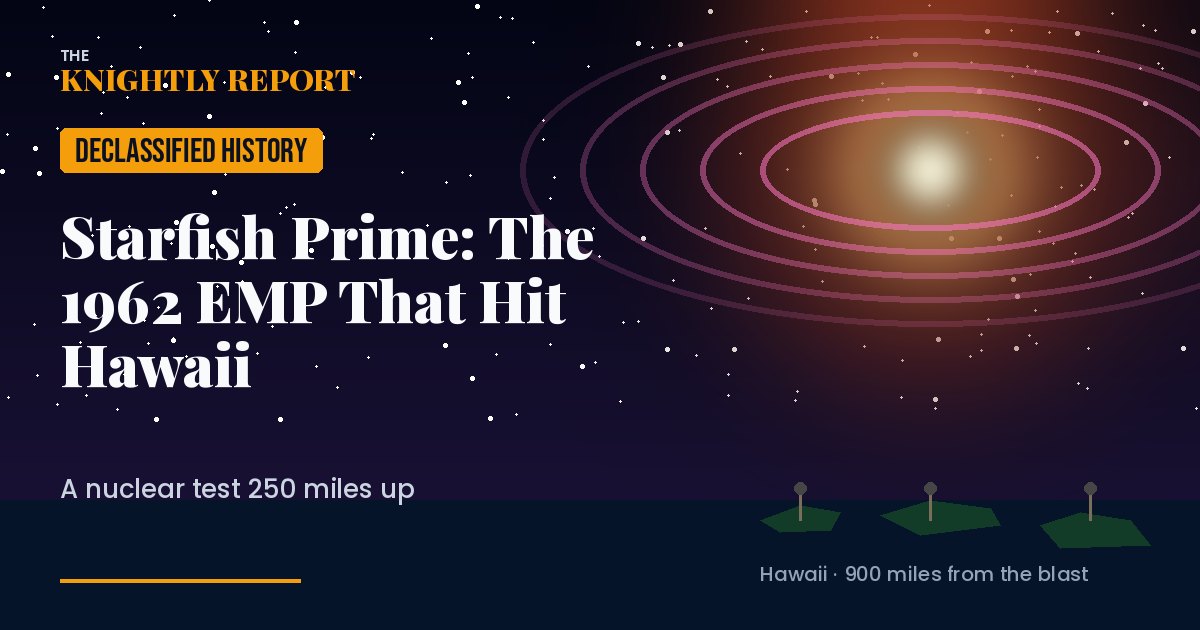
Short answer: Starfish Prime was a 1.4-megaton US nuclear test set off 250 miles (400 km) above Johnston Atoll in the Pacific at 11:00 p.m. Hawaii time on July 8, 1962. Its electromagnetic pulse (EMP) was far bigger than scientists expected. In Hawaii, about 900 miles away, it was linked to roughly 300 streetlights failing, burglar alarms going off, and damage to a telephone microwave link that cut calls between Kauai and the other islands. The radiation it left in orbit went on to damage or disable at least six satellites. It wasn't a conspiracy theory. It's documented in declassified government reports.
What follows is what the record shows, what's still argued over, and why the test still matters for anyone who depends on electronics.
What was Starfish Prime?
Starfish Prime was one of five high-altitude shots in Operation Fishbowl, part of the 1962 Operation Dominic test series. The US resumed testing after the Soviet Union announced in August 1961 that it was ending a three-year testing moratorium.
The documented facts:
| Detail | Record |
|---|---|
| Date and time | July 9, 1962, 09:00:09 UTC (11:00 p.m., July 8, Honolulu) |
| Launch site | Johnston Atoll, about 900 miles (1,450 km) west-southwest of Hawaii |
| Delivery | Thor rocket carrying a W49 thermonuclear warhead |
| Altitude | About 250 miles (400 km) |
| Yield | About 1.4 megatons |
| Earlier attempt | June 20, 1962 launch failed; the missile and warhead were destroyed in flight, spreading debris and some contamination on and around Johnston Atoll |
The goal was to measure what a nuclear blast does in near-space, because earlier high-altitude tests had been, in the government's own words, "poorly instrumented and hastily executed."
What happened in Hawaii that night
People in Honolulu watched the sky light up. Some hotels reportedly held rooftop "rainbow bomb" parties. Then came the electrical effects that made the test famous:
- Streetlights failed. Around 300 streetlights went dark in Hawaii, including strings of lights in Honolulu neighbourhoods.
- Burglar alarms went off across the islands.
- A telephone company microwave link was damaged, cutting telephone calls from Kauai to the other Hawaiian Islands.
The EMP was so much larger than predicted that it drove much of the test instrumentation off scale, which made precise measurement difficult.
What the official record actually concluded
This is where "what people repeat" and "what the record shows" part ways.
What EMP alarmists often say
Popular retellings sometimes describe Starfish Prime as having "blacked out Hawaii" or "fried the islands' electronics."
What the declassified analysis shows
The most detailed public review is a 1989 Sandia National Laboratories report by Charles N. Vittitoe, titled Did High-Altitude EMP Cause the Hawaiian Streetlight Incident? Working from interviews with the 1962 Honolulu street-lighting foreman and Hawaiian Electric engineers, plus lab tests on a period isolation transformer, Vittitoe concluded:
- The EMP swept across the streetlight circuits, and the induced voltages "were at the threshold for causing the observed fuse damage."
- That is "consistent with this damage occurring in only some of the strings in the systems."
In other words, yes, the EMP did real damage 900 miles away, but it was patchy and limited to vulnerable circuits. No, Hawaii was not blacked out. Most of the grid kept running.
Why that's more worrying, not less
The 1962 damage happened to simple, robust, mostly analogue equipment. Hawaii was also far from the burst and off to one side of it. Congress set up an EMP Commission, whose reports (2004, 2008 and 2017) argued that today's microprocessor-dependent infrastructure is more vulnerable than the systems of 1962. In 2019, Executive Order 13865, "Coordinating National Resilience to Electromagnetic Pulses," directed federal agencies to assess and reduce EMP risk to critical infrastructure. The EMP Commission's worst-case scenarios are contested by some utilities and researchers. But the federal government formally treating EMP as a resilience issue is a matter of record.
The damage you didn't hear about: satellites
The bigger long-term effect was in orbit. Starfish Prime injected huge numbers of high-energy electrons into Earth's magnetic field, creating an artificial radiation belt many times more intense than the natural inner belt.
- In the months that followed, that radiation caused six or more satellites to fail, according to NASA and historical accounts.
- Casualties included Telstar 1, the first commercial communications relay satellite, and Ariel 1, the UK's first satellite.
- Measurements published in 1968 suggested some of the electrons stayed trapped for about five years.
A year after the test, in 1963, the US and USSR signed the Partial Nuclear Test Ban Treaty, banning nuclear tests in the atmosphere, in space and under water.
Questions still worth asking
- How much was known in advance? Physicist Nicholas Christofilos had partly predicted the auroral effects, and hotels held viewing parties. Yet the EMP itself was still a surprise in size. How well did officials understand the risk to civilian systems before they pulled the trigger?
- How much is still classified? A good deal of Starfish data has been released, including a declassified AEC film, High Altitude Weapons Effects. Detailed weapons-effects data on modern systems isn't public, so outside analysts are left to extrapolate.
- Has protection kept up? The EMP Commission argued for years that hardening was lagging. Supporters of grid-hardening say progress is still too slow. Utilities point to ongoing standards work. The public record doesn't settle the debate, which is exactly why households hedge.
What Starfish Prime means for your preparedness plan
You can't harden the grid. You can make sure the gear you'd need afterwards is protected and can recharge on its own.
- Keep spares shielded. Store a backup radio, a phone, a small power bank and critical chargers in a properly built Faraday enclosure. Here's how: DIY Faraday cage for a solar generator.
- Own a power source that doesn't need the grid. A LiFePO4 power station with solar input can run lights, communications and a fridge. Size it with our 72-hour blackout battery sizing guide and our grid-down solar generator guide.
- Think about whether it'll survive. The Grid Doctor 3300 sold in our store is listed with a 3,300Wh LiFePO4 battery, a 3,000W pure sine inverter (6,000W surge), up to 1,600W of solar input and an "EMP intercept shielding enclosure and fast breakers." Note that EMP-hardening claims are the seller's. We haven't seen independent military-standard test results, so pairing any unit with a Faraday storage plan is the conservative approach. Read our full Grid Doctor 3300 EMP protection review.
History already ran the test
In 1962, a single burst 900 miles away reached Hawaii's streetlights and phone lines. See the Grid Doctor 3300 and the store's solar power stations, and put a protected power source on your side of the ledger.
Frequently Asked Questions
What was Starfish Prime?
A US high-altitude nuclear test on July 9, 1962 (July 8 in Hawaii). A Thor rocket carried a 1.4-megaton W49 warhead about 250 miles above Johnston Atoll in the Pacific, where it was detonated.
Did Starfish Prime cause a blackout in Hawaii?
No, not a general blackout. About 300 streetlights failed, burglar alarms went off, and a telephone microwave link to Kauai was damaged. A 1989 Sandia review concluded the EMP caused fuse damage in only some streetlight circuits.
How far was Hawaii from the Starfish Prime explosion?
About 900 miles (1,450 km). The blast was over Johnston Atoll, west-southwest of Hawaii, and appeared about 10 degrees above the horizon from Hawaii.
Did Starfish Prime damage satellites?
Yes. The artificial radiation belt it created caused six or more satellites to fail in the following months, including Telstar 1 and Britain's Ariel 1.
Could a Starfish-type EMP happen today?
Atmospheric and space nuclear tests have been banned under the 1963 Partial Test Ban Treaty for its signatories. A deliberate high-altitude EMP attack is a threat that the EMP Commission and Executive Order 13865 treat as a resilience concern, though how severe the effects would be is debated.
How do I protect electronics from an EMP?
Common steps include storing spare electronics in a Faraday enclosure, keeping a solar-rechargeable battery system, and having non-digital backups for critical needs. No home method is guaranteed, and product EMP claims should be checked for independent testing.
Sources
- Vittitoe, C. N., Did High-Altitude EMP Cause the Hawaiian Streetlight Incident?, Sandia National Laboratories, SAND88-3341 (1989): https://www.osti.gov/servlets/purl/6151435 (mirror: https://www.futurescience.com/emp/Vittitoe.pdf)
- Wikipedia, Starfish Prime (summary with citations to DTRA, DoD "Quick Look" report, NASA): https://en.wikipedia.org/wiki/Starfish_Prime
- Defense Threat Reduction Agency, Operation Dominic I – 1962 (Berkhouse et al., 1983), Chapter 7, Fishbowl high-altitude events
- Stassinopoulos, E. G., "The STARFISH Exo-atmospheric, High-altitude Nuclear Weapons Test," NASA Goddard (2015)
- Hess, W. N., The Effects of High Altitude Explosions, NASA TN D-2402 (1964)
- American Physical Society, APS News on electromagnetic pulse (Nov 2022): https://www.aps.org/apsnews/2022/11/electromagnetic-pulse
- Executive Order 13865, "Coordinating National Resilience to Electromagnetic Pulses" (Federal Register, March 29, 2019): https://www.federalregister.gov/documents/2019/03/29/2019-06325/coordinating-national-resilience-to-electromagnetic-pulses
- Report of the Commission to Assess the Threat to the United States from Electromagnetic Pulse (EMP) Attack (2004, 2008; 2017 reports)
- The Knightly Report store listing, Grid Doctor 3300: https://knightlyreport.com/shop/
The Knightly Report operates free from pharmaceutical conglomerates, government subsidies, or corporate party PACs. Every investigation is verified against official legislative hearings, federal data sets, or direct primary source documentation. If you spot a factual discrepancy, contact our editorial desk for verification.
Keep the lights on when the grid goes down
The seller markets the Grid Doctor 3300 as an EMP-hardened solar generator system (3,300Wh LiFePO4, 3,000W pure sine). Read our Grid Doctor 3300 review or compare the store's portable power stations.
See the Grid Doctor 3300 & power stations →Disclosure: The Knightly Report earns revenue when you buy through our store links. Grid Doctor specifications and EMP-protection claims are the seller's own claims; we have not independently tested EMP resistance.